




Introduction and Foreword
One warm introduction could change your life.
Or at the very least, it could be the difference between hitting or missing quota.
Leveraging your network is one of the most reliable ways to generate a quality pipeline and yet, most sales teams aren’t set up to use their networks in a consistent or effective way. Which means teams are only building pipeline with the outreach methods they've always relied on and missing out on significant revenue potential.
We surveyed 1,305 sales leaders to understand the scope of this pipeline shortfall. The results revealed a clear gap, more specifically, a Warm Intro Gap.
Sales pipeline is being built, but not at the level required to hit quota. The gap between reality and revenue goals grows bigger each year, which results in finger pointing, high churnover among sellers and leaders, and frustrated boards, investors, and execs.
Yet, there is a clear path to closing that gap. The teams that are hitting their goals consistently seem to have one thing in common, they all leverage warm introductions and referrals. So why aren’t all sales teams following suit?
Some point to the lack of a formal process. Others cite psychological barriers—fear of asking, uncertainty about timing, or concern about damaging relationships.
The good news is that none of these need to hold your team back. This guide breaks down the most common barriers preventing teams from activating their networks and shows you exactly how to overcome them so you can consistently generate warm pipeline and close the gap for your own team.
The data that follows comes from sales leaders doing the work every day and shows a clear (and reliable) story about how valuable warm introductions are and how they can be one of your biggest assets.
My hope is that this guide helps teams build deeper, more intentional networks and use them in a way that feels human, repeatable, and impactful, and of course, close the gap between pipeline attainment and revenue goals.
Happy selling and happy connecting,
Mac Reddin
Founder of Commsor
About This Guide
Sales teams aren’t missing quota because they aren’t working hard enough. Trust us, between the endless resetting of quotas, back-to-back calls, and the constant need to meet activity benchmarks, we know sellers are some of the hardest working people at any organization.
But they’re missing quota because the motions they rely on most, cold calls, cold emails, and outbound sequences, are no longer sufficient on their own.
Warm revenue is the future of sales.
To close the gap between what traditional sales methods can attain and the ever growing, ever moving targets set by leaders, warm revenue, more specifically pipeline sourced from warm introductions, should be a growing channel that should be leveraged, measured, and tracked by every sales team.
Warm introductions have always been one of the most powerful, yet least understood (and also least tapped into), sources of pipeline. That’s why we created The Warm Intro Gap: a guide to uncover how top sellers are leveraging their networks to hit pipeline goals and uncover what’s holding other teams back from getting started.
In this guide, our team will walk you through:
- Why traditional outreach methods alone are no longer enough
- How to quantify the gap between pipeline creation and quota attainment
- Why warm intros work and why sellers rarely ask for them
- How top-performing teams close that gap with warm introductions and referrals
- A clear, repeatable path to operationalizing your network
To do this, we went straight to the people responsible for generating revenue every day.
We surveyed 1,305 sales leaders to capture a real, unfiltered look at how teams think about referrals, warm paths, and the evolving effectiveness of traditional outbound.
Our hope is that this research helps sales teams understand what top performers already know intuitively:
Warm, trusted relationships don’t just improve conversion. They reshape your entire revenue engine by reducing touchpoints, accelerating the sales cycle, increasing ACV, and creating healthier pipelines that compound over time.
We hope this report gives you clarity, confidence, and a more human path to sustainable revenue
Who Did We Hear From?
Personal Demographics
Gender
Our survey included 1,305 GTM professionals representing a broad mix of personal backgrounds. Respondents were almost evenly split by gender, with 49.8% identifying as female and 49.9% as male.
Age Range
Age distribution skewed mid-career, with the majority between 25–44 years old (61.8%), followed by 45–54 (21.2%) and smaller groups in younger and older brackets.

Location
Geographically, the sample was overwhelmingly based in North America (90%), with additional representation from South/Central America, EMEA, APAC, and other regions.
Work environments varied across on-site (53.9%), hybrid (32.9%), and fully remote roles (13.2%).
Professional Demographics
Seniority
Our respondents reflected a diverse range of professional backgrounds across GTM and revenue teams. Most held manager or team lead roles (62.3%), alongside directors (13.7%), C-level executives (18.4%), and a smaller share of VPs and other roles. Experience skewed mid-to-senior, with the majority reporting 4–10 years in GTM (53.8% combined) and another 27.4% having 11+ years of experience.
Company Size and Industry
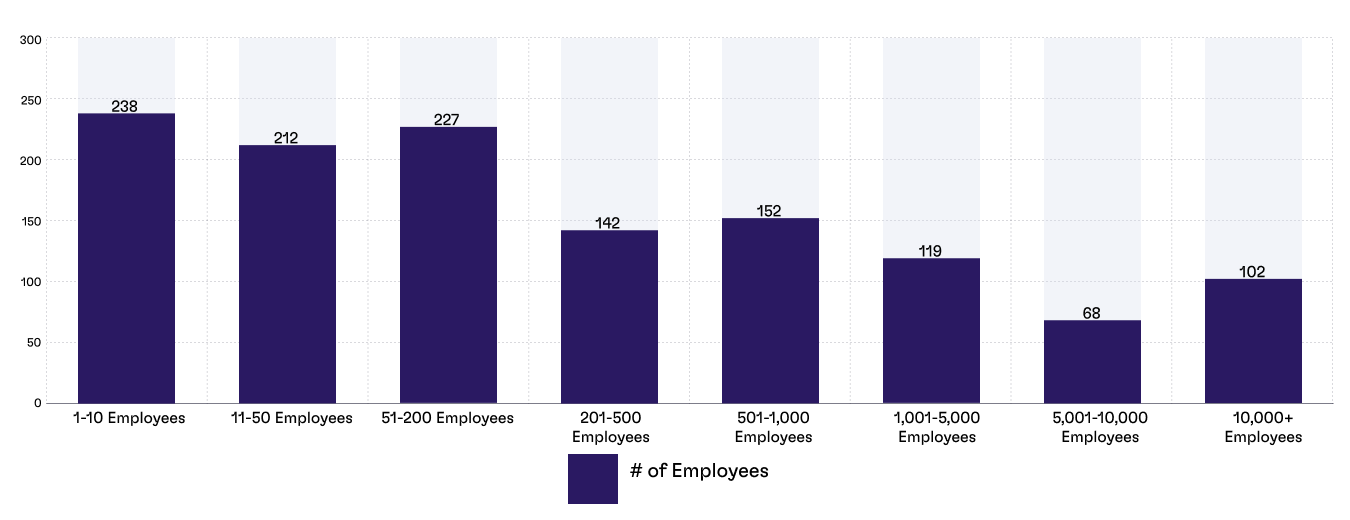
Participants came from companies of all sizes. From 1–10 employees (18.9%) to 10,000+ (8.1%), and represented a broad set of industries including retail, travel & hospitality, financial services, SaaS, manufacturing, healthcare, and more.
Deal Cycles
Deal sizes varied considerably as well: while ACVs ranged from under $5k to over $1M, the largest concentration fell between $50k–$250k. Sales cycles also varied, with most respondents operating within 1–6 month cycles.
Types of Sales
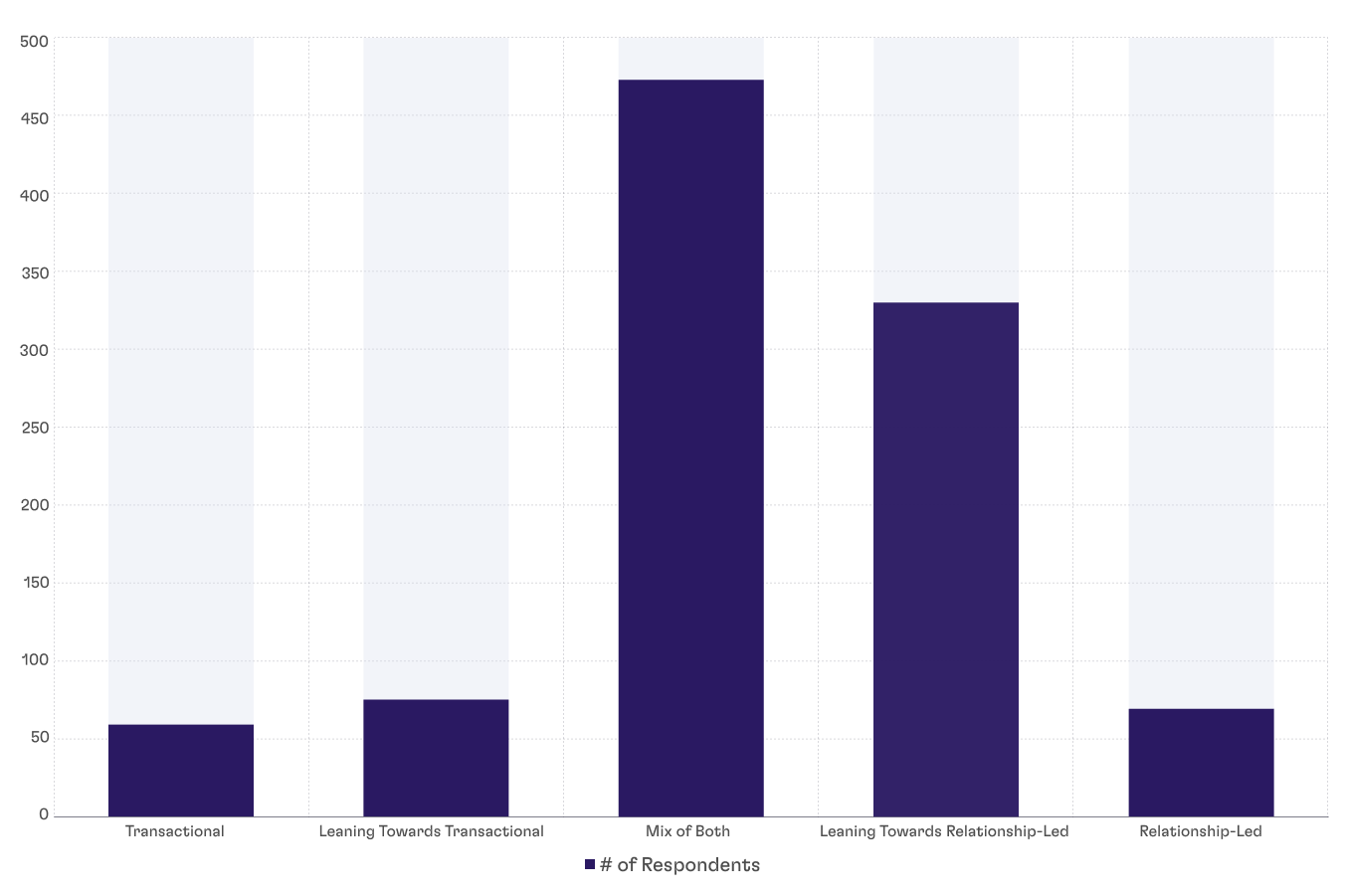
Most teams see their sales motion as a blend rather than an extreme. 40.1% of respondents describe their process as a mix of transactional and relationship-led, while 48.5% lean more heavily toward relationship-led sales (ratings 4–5).
Only 11.4% report a primarily transactional approach, suggesting a broad shift toward relationship-driven selling, even if it’s not yet fully operationalized.
“Transactional sales” are defined as shorter-term sales that concentrate on increasing individuals sales quickly whereas “relationship-led sales” focus on building strong, long-term connections with customers and engaging them over time.
Sales in 2025: Activity Is Up, Results Are Not
This narrative isn’t anything new, but it’s worth repeating until something changes.
Sales teams are working harder than ever and getting less in return.
Take it from the mighty Brontosaurus who knows this plight well. Of all the dinosaurs, when it came to getting food it had to travel furthest and spend the most time feeding, but in the end, ended up burning more energy simply maintaining the baseline for survival. It certainly worked harder than any other dinosaur, but at what cost?
Over the past decade, outbound selling has evolved into a volume-driven machine. Sales teams have more tools, more data, and more automation at their disposal than at any point in history. On paper, this should mean more pipeline and more predictable revenue.
In reality, the opposite is happening. Sellers are doing more activity than ever, and just like the Brontosaurus, are only able to “maintain the baseline survival” when it comes to closing revenue.
The Evolution of Outbound
Outbound used to be scarce. Or should we say, scarcer. Sales reps researched accounts, personalized outreach, and relied on timing and relevance to earn responses. Now, with AI at everyone’s disposal across all stages of the sales cycle, outbound is more than abundant, and that abundance has fundamentally changed buyer behavior.
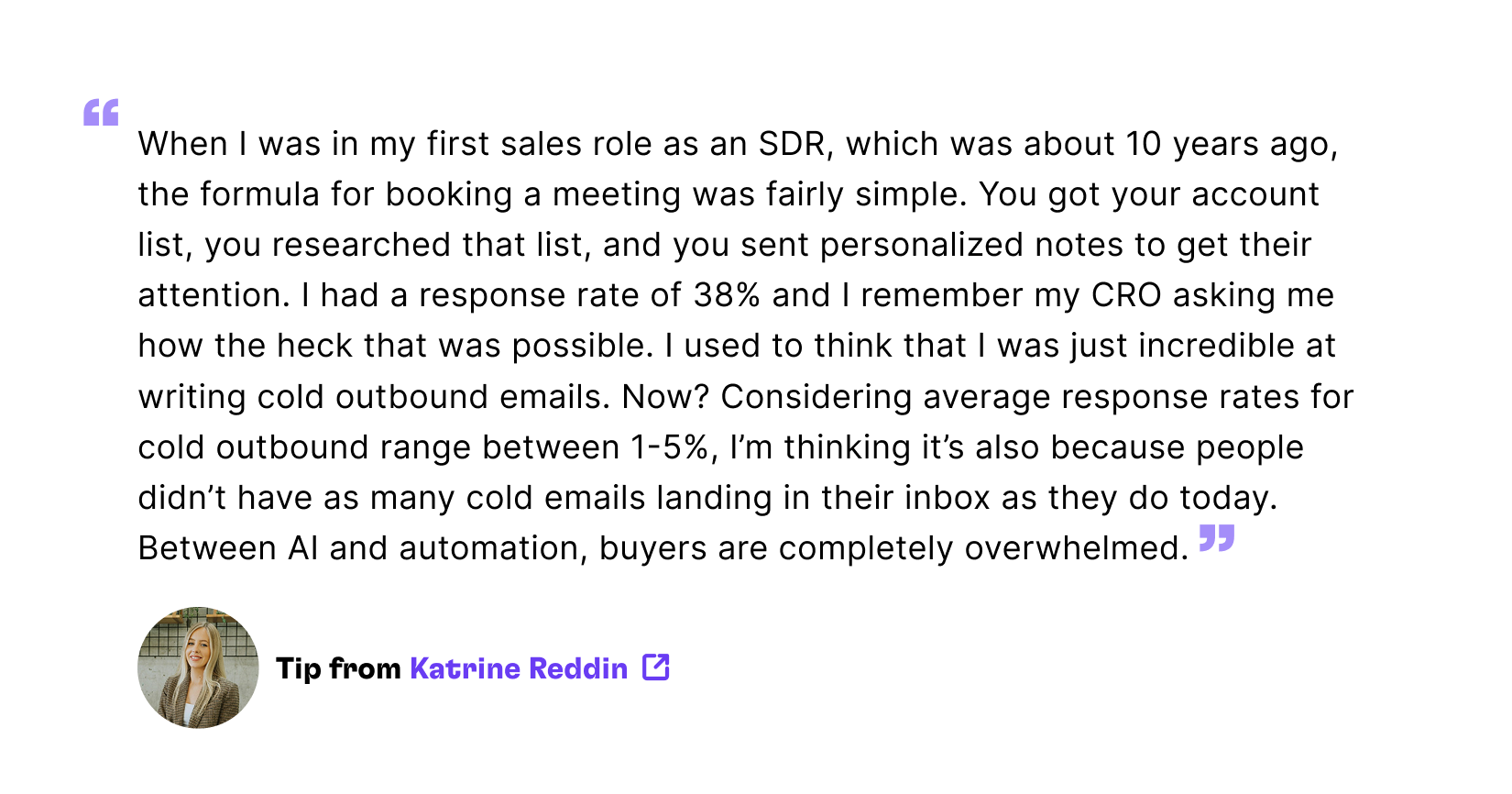
Automation has made it easy to send thousands of emails, sequence dozens of touches, and spin up new reps quickly. AI has lowered the barrier even further, enabling teams to scale messaging faster than ever before. At the same time, more companies are selling into the same finite pool of buyers.
In 2026 there’s more noise, more competition, and far less success.
That doesn’t sound like a recipe for success to us…
Why Cold Outreach Is Harder Than Ever
Buyers are overwhelmed. Inboxes are saturated with templated “personalization,” LinkedIn messages blur together, and cold calls are screened or ignored. What once felt like proactive outreach now feels like interruption.
This has led to several compounding challenges:
- Lower response rates: Even best-in-class teams are seeing diminishing returns on traditional outbound. Opens don’t lead to replies, replies don’t lead to meetings, and meetings don’t reliably turn into revenue.
- Increased buyer resistance: Buyers are more skeptical, more guarded with their time, and more likely to disengage at the first sign of generic messaging.
- Higher expectations for relevance and personalization: Surface-level personalization no longer works. Buyers expect sellers to understand their business, their context, and their priorities, before asking for time.
When asked how the effectiveness of cold outbound has changed over the past three years, respondents point to a clear pattern: cold outreach now requires more effort, more personalization, and higher-quality targeting to work.
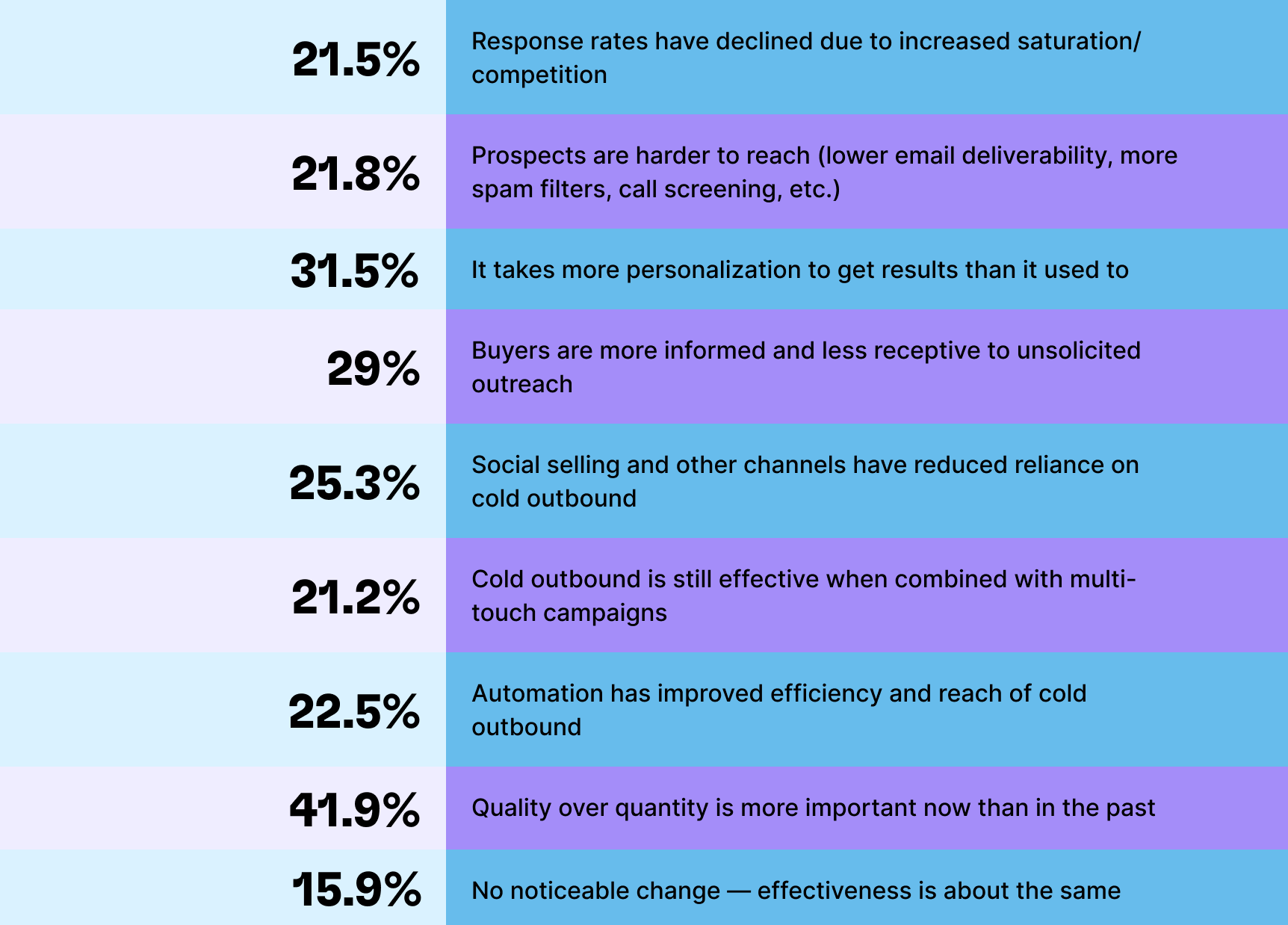
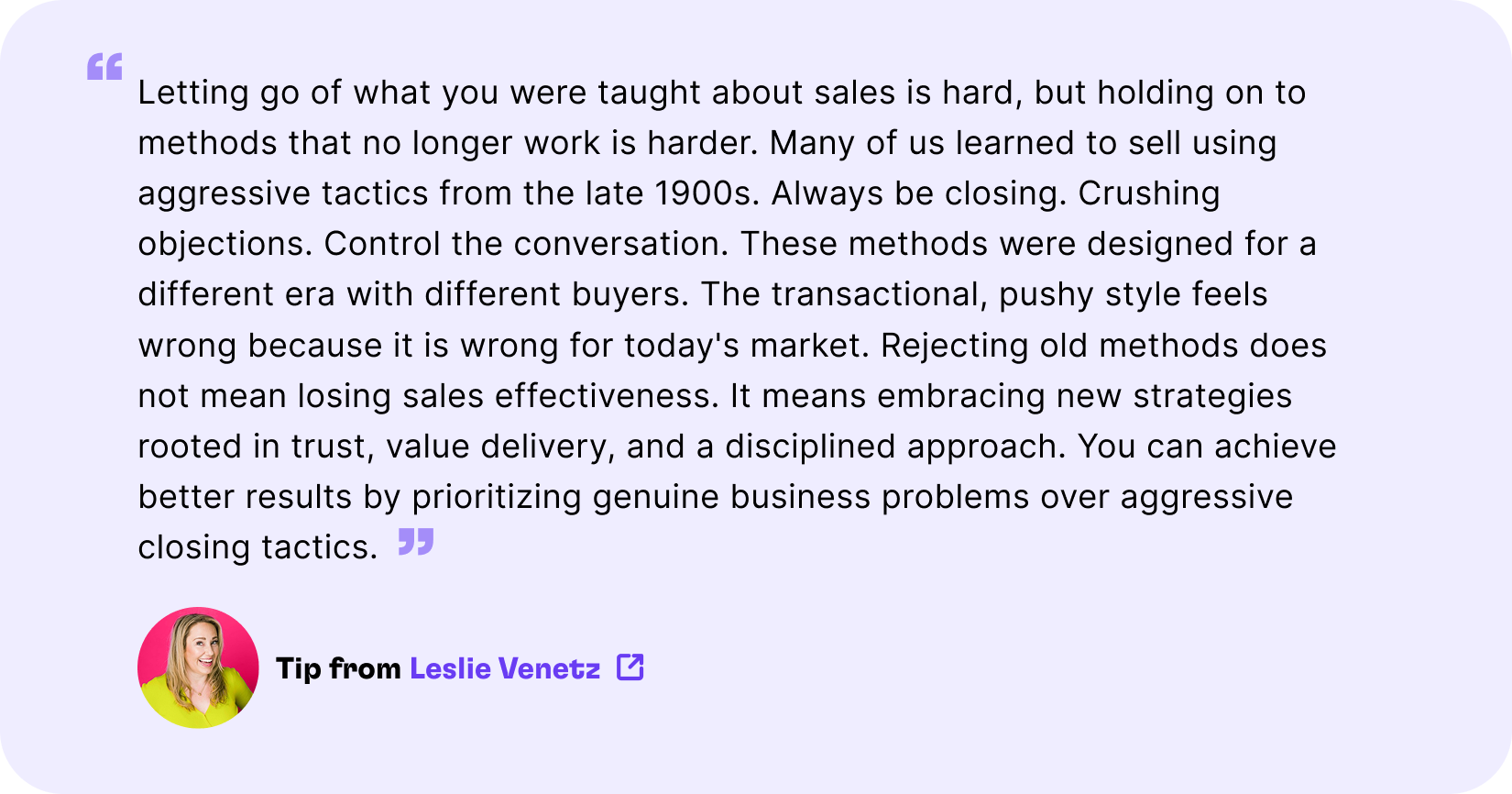
Cold outreach hasn’t stopped working entirely, but it no longer works at scale on its own.
The amount of outbound touch points required to get a deal in your pipeline has gone up 5x in the last 5 years, hitting 1400!
When it takes you 1400 actions to accomplish booking a meeting, one can’t help wonder, is there not a way to work smarter, not harder?
As traditional outreach becomes less effective, sales teams have responded the only way they know how:
By doing more.
More emails. More calls. More tools.
AI as A Crutch For Sales: Unintended Consequences
Enter the age of AI—an era we’ll soon look back on the way we do the Jurassic period: fascinating, dominant in its time, and ultimately destined for extinction once it becomes clear it can’t solve every sales pipeline problem.
You literally can’t walk down the metaphorical street without hearing the word AI or seeing one of the tools in your sales tech stack announcing they’ve incorporated it into their platform.
While AI has undeniably improved efficiency in sales, but it’s increasingly becoming a crutch among sellers and leaders, and one that isn’t sustainable.
AI excels at routine tasks like drafting emails, scoring leads, and summarizing calls. What it can’t replicate is the human element, emotional intelligence, and strategic thinking required for building relationships with buyers.
When teams lean too heavily on AI, core skills like writing compelling outreach, adapting messaging in real time, and navigating objections begin to erode. Sellers default to machine output instead of sharpening their craft.
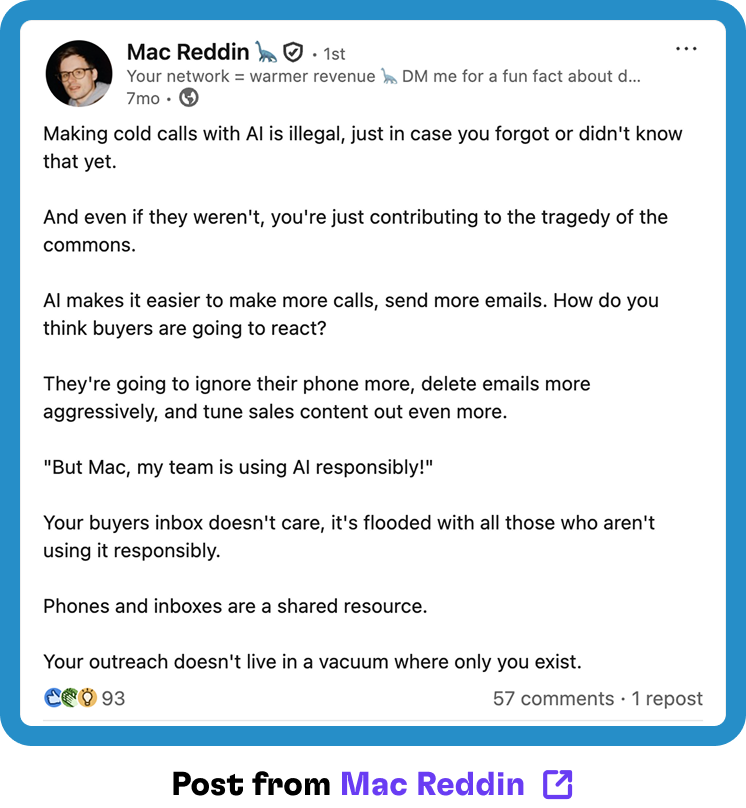
AI also struggles with context, accuracy, and trust, which is a problem considering trust is one of the most important things a seller needs. Buyers can quickly detect when AI-generated outreach feels generic or robotic, which leads to engagement drops and response rates suffer, undermining the very efficiency AI promises.
More activity doesn’t automatically mean better results. So when AI-powered sales tech is designed primarily to help teams “do more,” leaders need to pause and ask a harder question: is this actually building a durable sales strategy or just accelerating an unsustainable one?
Numbers to Consider
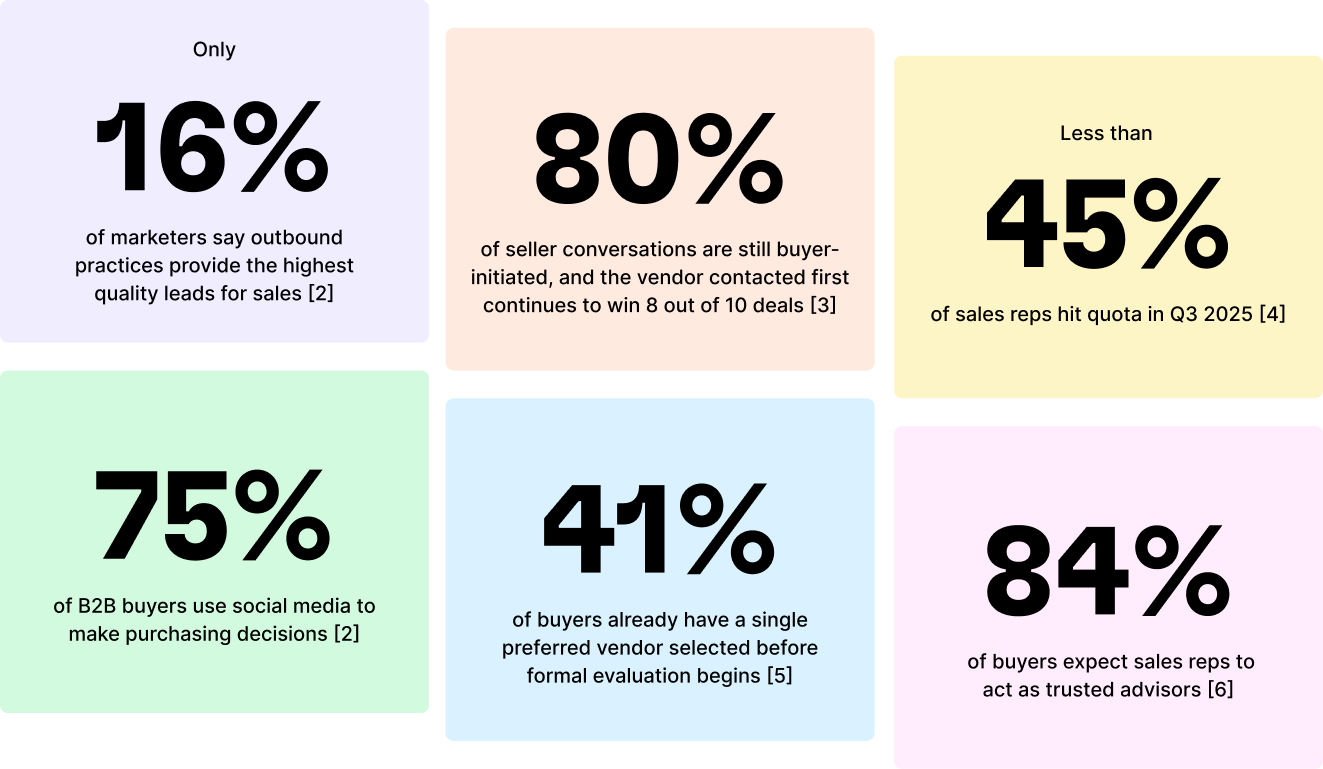
The way buyers buy, and therefore how sellers must sell, has fundamentally changed. Faced with these shifts, it’s tempting to believe that AI and automation will fix the problem. In reality, they often fuel the very surge in activity that makes modern outreach less effective in the first place.
The good news is that strong results don’t require choosing between short-term wins and long-term growth. You can build for both. The path forward isn’t about doing more—it’s about doing things differently. Work smarter, not just harder. Read on and jump in!
Pipeline vs. Quota
Sometimes, it takes cold, hard facts to shake up a routine.
Here’s one that should stop you in your tracks if the rest of this guide hasn’t already: only 23.6% of the 1,305 sales leaders we surveyed said their teams hit revenue goals in 2025.
Yikes. Numbers like that aren’t just alarming, they’re a clear signal that a new strategy is overdue.
The majority of leaders point to outbound challenges as the culprit:
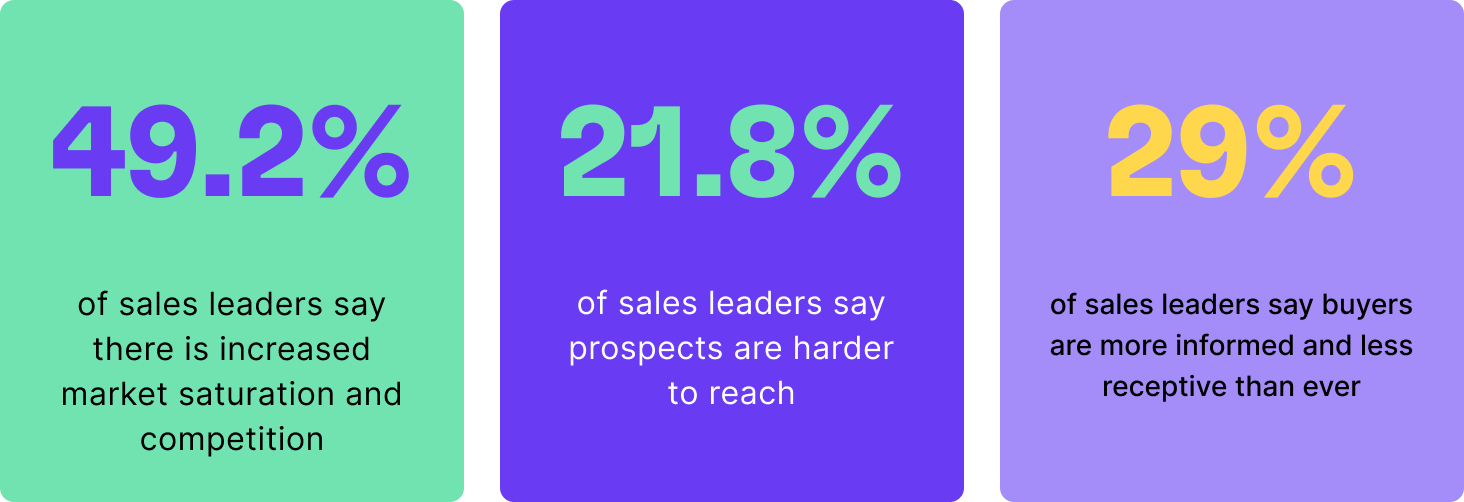
One thing is clear, sales leaders are in agreement that current outbound methods alone aren’t enough to hit targets.
So if the way we’re operating today isn’t getting the results we want, how do we close the gap? The answer lies in combining traditional outbound with warm revenue tactics.
Declining outbound effectiveness, tighter budgets, and buyers’ growing skepticism create a perfect storm for missing quota. Deals stall, win rates drop, sales cycles stretch, and reps burn out chasing opportunities that were never warm to begin with.
Sales teams aren’t underperforming, they’re over-relying on motions that no longer scale on their own.
The gap between pipeline creation and revenue attainment isn’t about lack of effort from individual sellers, it’s about the lack of investment in other revenue strategies. Until teams supplement cold outreach with trust-based, network-driven entry points, that gap will continue to widen and opportunities will keep slipping through the cracks.
What is the Warm Intro Gap?
The Warm Intro Gap is the disconnect between pipeline creation and quota attainment, a gap that exists because sales teams aren’t fully tapping into their most valuable revenue sources: warm introductions, referrals, and network-driven connections.
While nearly half of teams surveyed (47.5%) reported generating 26–100% of their pipeline from referrals and warm intros, the reality is that these opportunities are inconsistently leveraged.
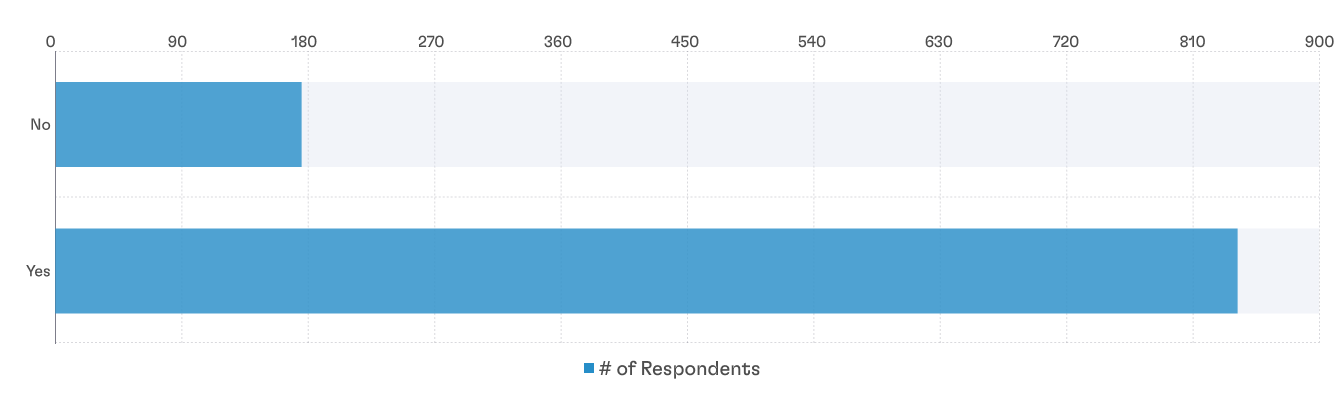
That inconsistency is costly. 82.4% of respondents say deals that start with a warm introduction or referral close faster than opportunities from cold outreach or other channels. Despite the clear speed advantage, many teams still treat warm intros as opportunistic rather than a repeatable motion, widening the Warm Intro Gap.
Do Deals from Warm Intros Tend to Close Faster Than Deals from Other Sources?
The irony is that 77.8% of sales leaders claim their teams would be prepared to continue driving revenue if cold outbound methods disappeared. Yet only 18% have a reliable warm-intro system set up. The math doesn't add up.
How can we expect sellers to consistently leverage a warm revenue strategy when there’s no process to support it?
Until we put a formal system in place, one that enables sellers to consistently tap their networks and turn warm introductions and referrals into pipeline, the gap between opportunities generated and revenue goals will continue to grow.
Warm Revenue Strategies and How it Outperforms Cold Outbound
A Warm Revenue Strategy (sometimes called Go-to-Network) is a deliberate, strategic approach where a business activates its networks to drive growth. These networks can include customers, partners, investors, communities, and personal connections.
Unlike cold outbound, where sellers proactively reach out to prospects with whom they have no prior relationship, warm outbound focuses on pulling opportunities into your sphere of influence by leveraging existing relationships and trusted networks. It’s about turning connections into predictable, high-quality pipeline rather than relying solely on outreach to strangers.
While warm revenue isn’t the ONLY way to build pipeline and close revenue, it makes selling fundamentally easier and more effective. It’s simply easier to start a conversation and move a deal forward when trust already exists with the buyer.
Warm revenue tactics give sellers a clear strategic advantage:

Warm introductions get buyers engaged faster and with less effort. 40.2% of sales leaders shared that warm intros result in booked meetings in just 1–2 touches, compared with 43.1% of cold outreach efforts requiring 3–5 touches to achieve the same outcome. Warm paths reduce friction, save time, and accelerate early engagement, making pipeline creation more efficient from the start.

Warm introductions and referrals also move deals through the pipeline at a higher velocity. A striking 82.4% of sellers say deals sourced through warm introductions close faster than those from other channels. The combination of pre-existing trust and credibility means buyers are already engaged and more receptive, shortening sales cycles and freeing reps to focus on higher-value opportunities.

In addition to speed across the full sales cycle, warm introductions also drive bigger deals. Nearly half of the sales leaders surveyed (49.4%) report that deals sourced via warm intros have higher average contract values (ACVs). Across every ACV tier, from <$5k to $1M+, respondents consistently report that warm paths contribute significantly to their pipeline. High-ACV companies, in particular, rely heavily on these warm channels to secure complex, strategic deals that cold outreach rarely achieves.
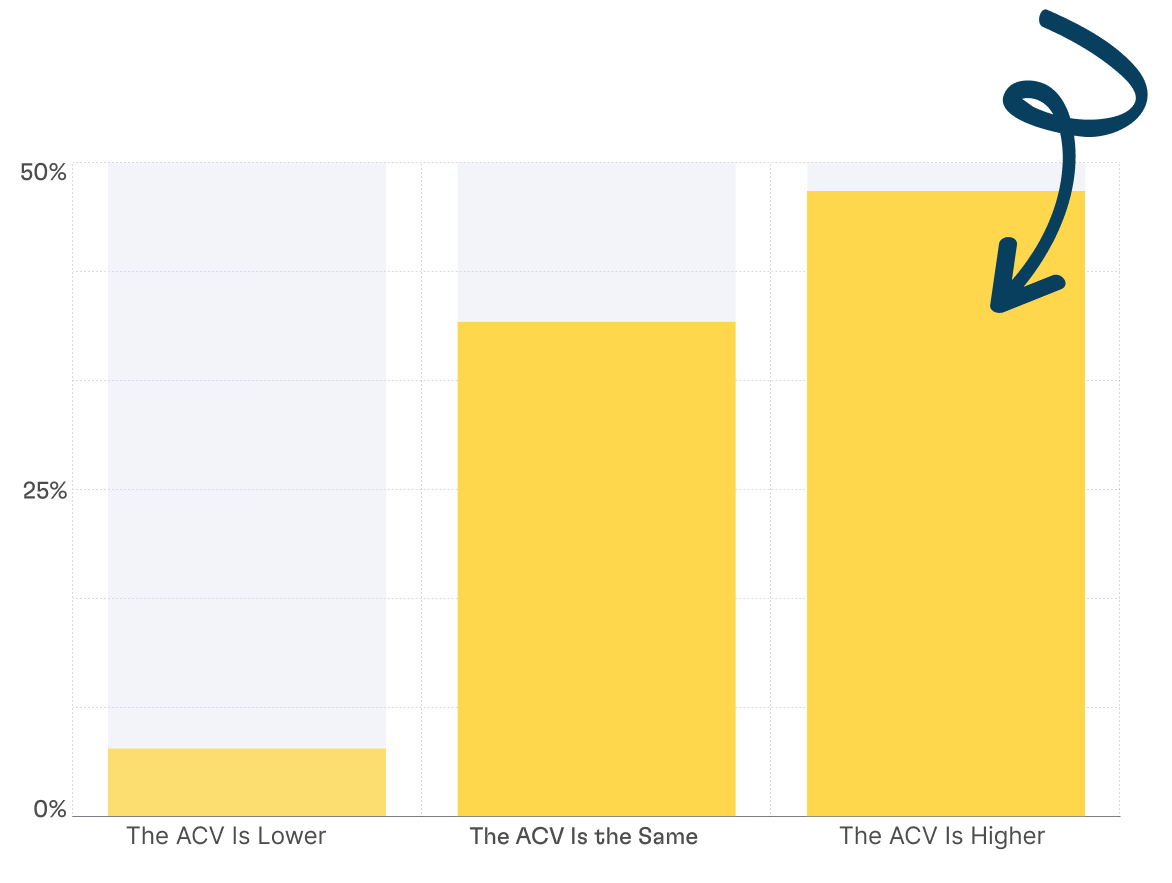
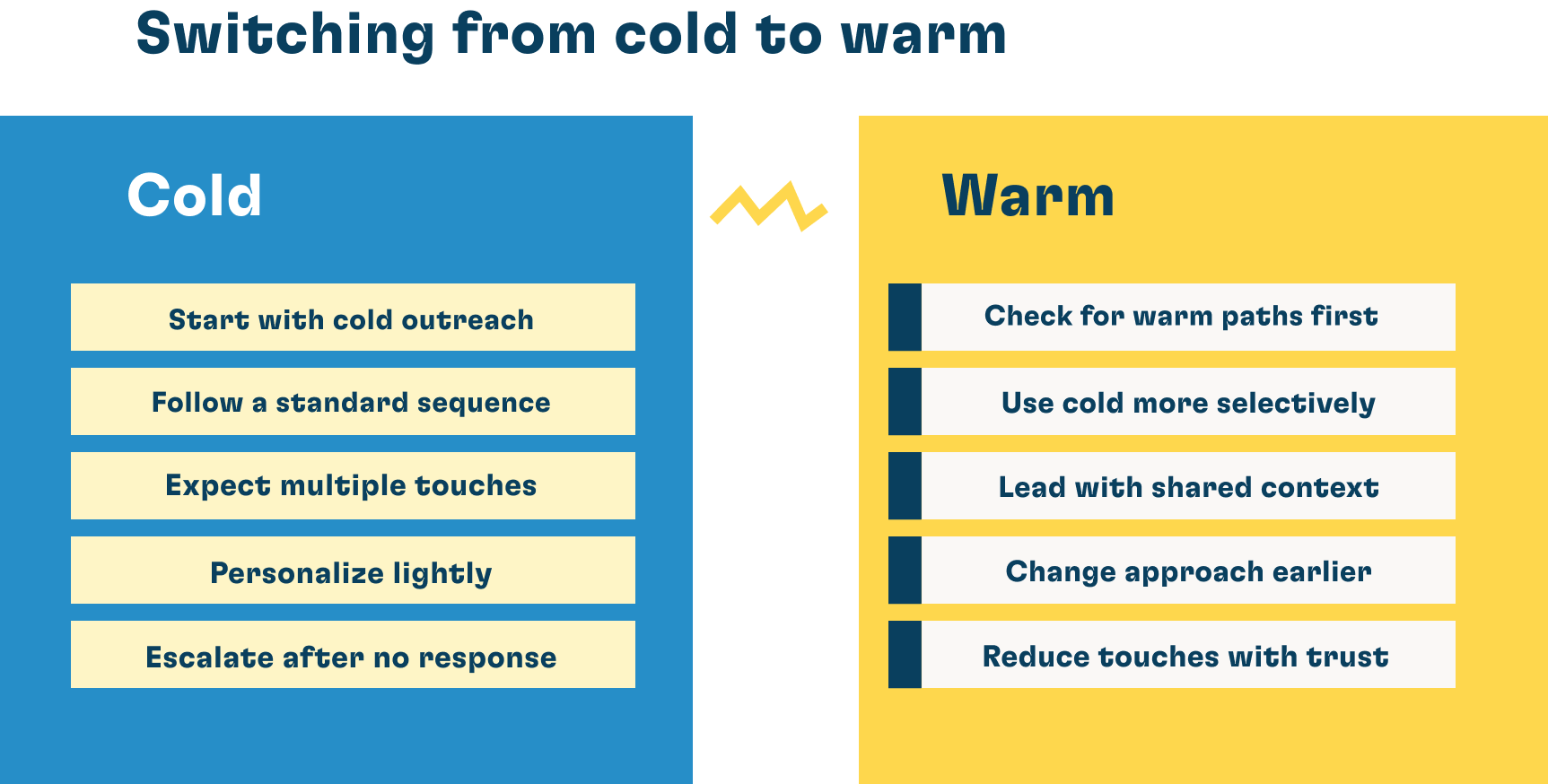
Integrating warm revenue tactics alongside traditional outbound isn’t optional, it’s essential for hitting revenue targets.
Why Sellers Don’t Leverage Their Network
Even though warm introductions and referrals are proven to drive pipeline, many sellers fail to consistently tap into their networks. There are several key reasons for this and understanding them is the first step toward closing the Warm Intro Gap.
There Is No Formal System In Place
One of the biggest barriers is structural: sellers simply aren’t given a repeatable, reliable system for leveraging their networks. Without formal processes, scripts, or clear guidance, even the most motivated reps struggle to turn relationships into consistent pipeline. Leaders may encourage warm introductions, but without a framework, encouragement rarely translates into action.
Emotional and Confidence Barriers Are the #1 Blocker
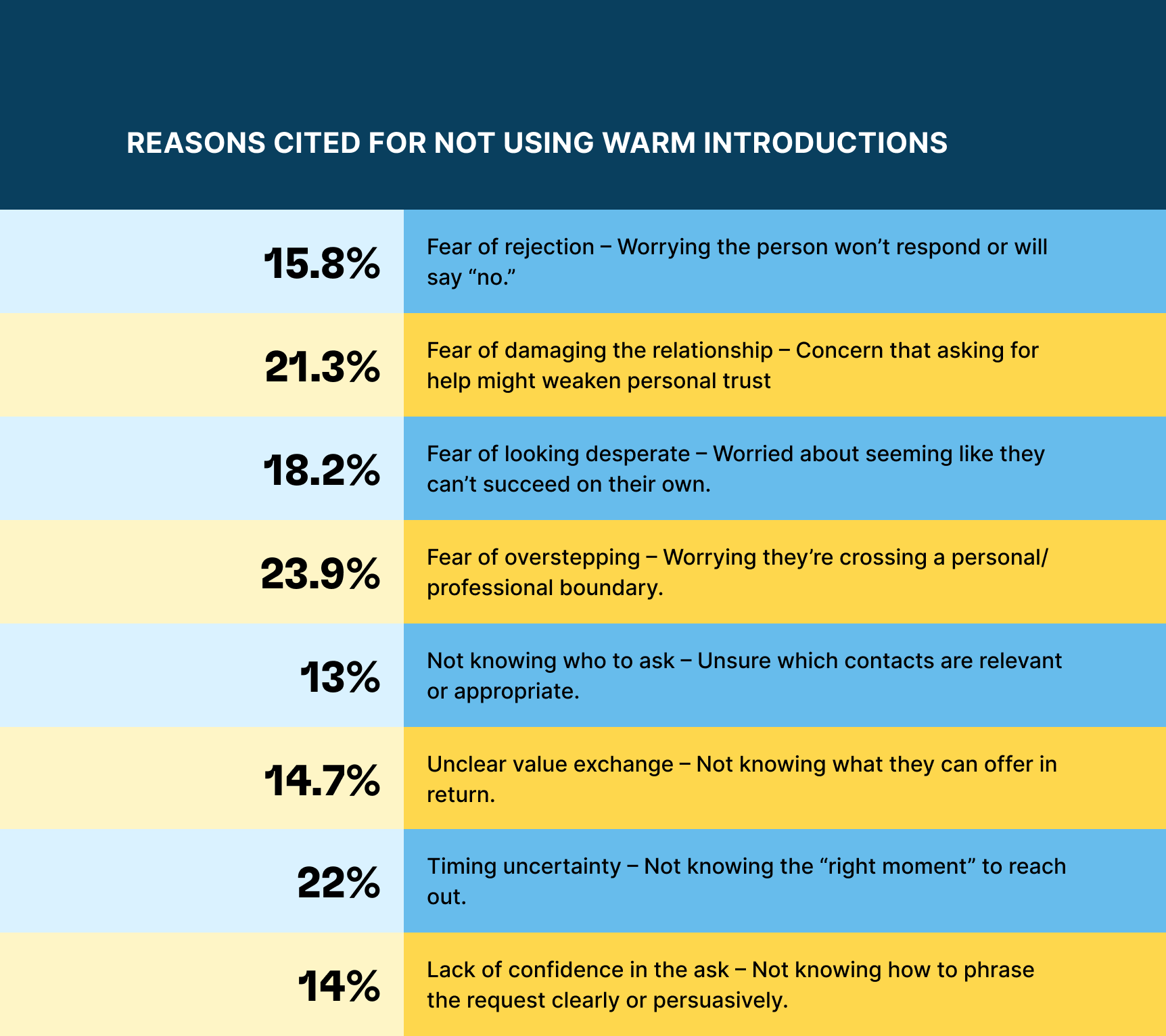
Sellers want to ask for referrals but fear often holds them back. 66.8% of sellers cite at least one fear-based barrier that prevents them from regularly asking for introductions or referrals, including:
- Worry about rejection
- Concern about overstepping or pressuring someone
- Fear of damaging existing relationships
- Uncertainty about who to ask
These emotional and confidence barriers are the largest single obstacle to network-driven selling. Even when reps know the value of warm intros, hesitation prevents them from asking consistently.
Sellers Lack Formal Training On How To Network
Many sellers learn networking informally, picking it up from a manager or mentor. 66.1% of reps report learning networking this way, while 11.6% receive no training at all. This means the rest of the training that exists is inconsistent, informal, or ad hoc.
Even worse, most companies fail to offer ongoing enablement. 55% of organizations do not provide continuous networking training, leaving only 44.9% of sellers with ongoing support to build and refine these critical skills.
Without training, even experienced sellers struggle to translate relationships into measurable pipeline.
Sellers Believe They’re Relationship-Led, but Behaviors Don’t Match
Many sellers see themselves as relationship-oriented rather than transactional but self-perception doesn’t always match reality. 48.5% rate themselves a 4–5 on being relationship-led, yet warm-intro usage remains inconsistent across teams. Without structured processes, reinforcement, and tracking, even “relationship-led” sellers fail to act on the networks they already have.
The Takeaway
Sellers don’t consistently leverage their networks because of a mix of structural, psychological, and skill-based barriers. To close the gap you need a mixture of enablement, confidence, and repeatable process.
Overall, the four things you need to do to close the Warm Intro Gap are:
- Put formal systems in place for asking for intros.
- Provide training and ongoing coaching on networking skills.
- Address emotional barriers, giving sellers scripts, guidance, and confidence.
- Align self-perception with behaviors, ensuring that being “relationship-led” translates into measurable action.
When these pieces come together, network-driven pipeline becomes reliable, predictable, and scalable, unlocking revenue that has been sitting untapped in sellers’ existing relationships.
Closing the Warm Intro Gap: A Quick Playbook for Sales Leaders
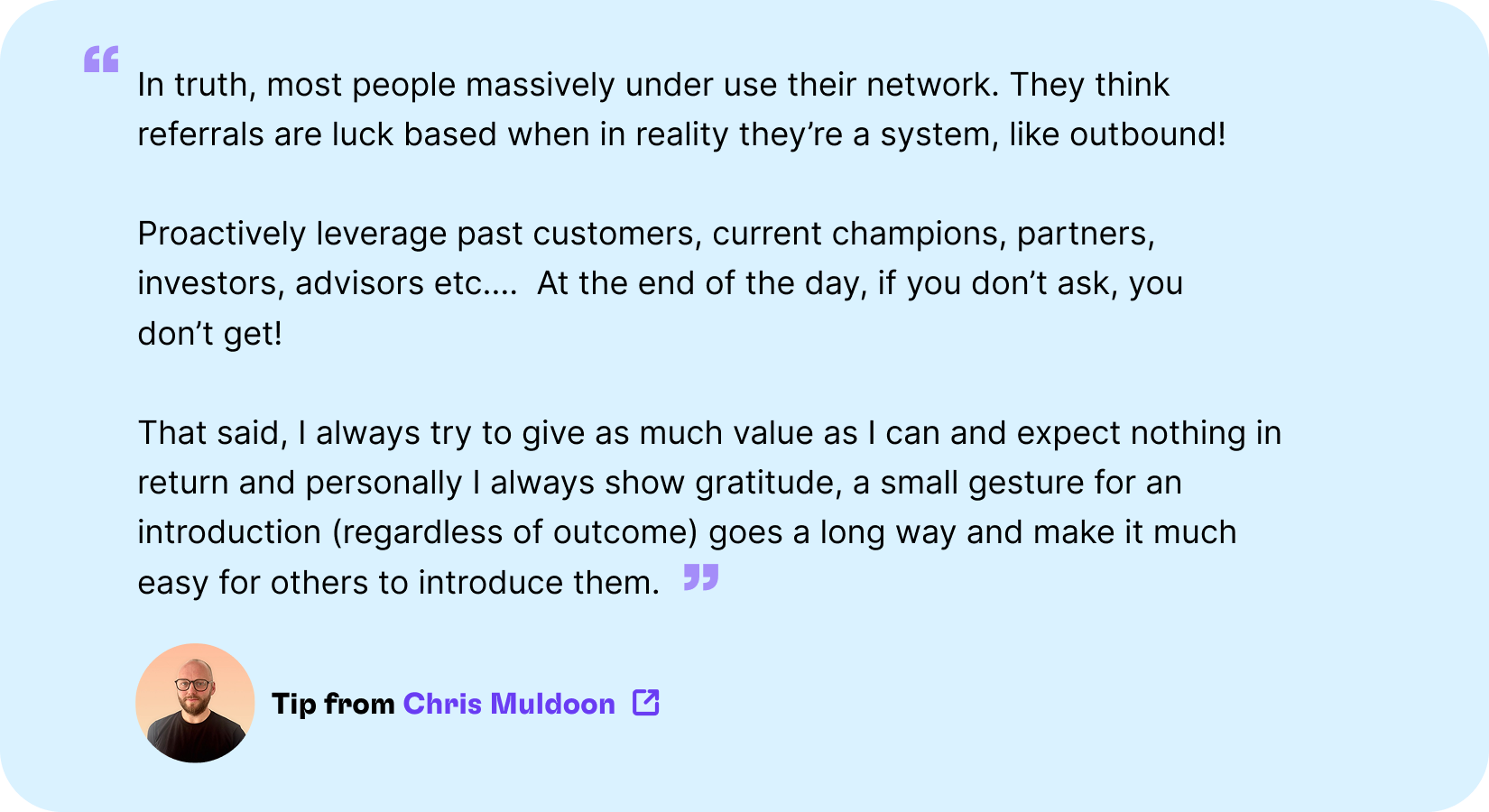
As previously discussed, sellers often fail to consistently leverage their networks because of structural, psychological, and skill-based barriers. Closing the Warm Intro Gap requires a deliberate mix of enablement, confidence, and repeatable processes.
Let’s break down exactly how sales leaders can make it happen.
Put Formal Systems In Place For Asking for Intros
Steps to Take:
- Build a standardized process for warm introductions: define when, how, and to whom sellers should ask.
- Incorporate warm-intro goals into CRM workflows so every potential opportunity can be tracked.
- Create templates, scripts, and email cadences for requesting intros to make the process easy and repeatable.
- Recognize and reward sellers who consistently leverage their networks to generate pipeline.
Outcome: Sellers know exactly what to do, when to do it, and how to measure success, removing friction and inconsistency from the process.
Provide Training and Ongoing Coaching on Networking Skills
Steps to Take:
- Offer formal onboarding sessions on networking best practices and referral strategies.
- Schedule regular skill-building workshops or role-play exercises to practice asking for intros.
- Assign mentors or champions who can provide guidance on strategic network activation.
- Track performance over time and provide continuous coaching on gaps or opportunities.
Outcome: Sellers develop confidence, fluency, and skill in leveraging their networks—turning informal knowledge into repeatable competency.
Address Emotional Barriers with Scripts, Guidance, and Confidence
Steps to Take:
- Identify the most common fears (rejection, overstepping, damaging relationships) through surveys or team feedback.
- Develop scripts and conversation frameworks that reduce anxiety and provide clear talking points.
- Encourage peer-to-peer sharing of success stories to normalize asking for intros.
- Reinforce a culture where asking for warm introductions is expected and supported, not optional.
Outcome: Sellers feel empowered to ask for introductions without hesitation, creating more consistent and predictable pipeline activity.
Align Self-Perception with Measurable Behavior
Steps to Take:
- Help sellers define what being “relationship-led” looks like in measurable terms (e.g., number of warm-intro asks per quarter, response rate from referrals)
- Use CRM tracking or dashboards to monitor warm-intro activity and outcomes.
- Provide coaching and accountability to ensure intentions translate into tangible behaviors.
- Celebrate results publicly to reinforce the link between relationship-focused behaviors and revenue outcomes.
Outcome: Sellers’ self-perception as relationship-led aligns with actual behavior, ensuring network-driven activities consistently drive results.
When these four levers come together—process, training, confidence, and accountability—network-driven pipeline becomes reliable, predictable, and scalable. Opportunities that were previously untapped in your sellers’ existing relationships are now activated, creating measurable revenue impact and closing the Warm Intro Gap once and for all.
Build Intentional Networks to Activate
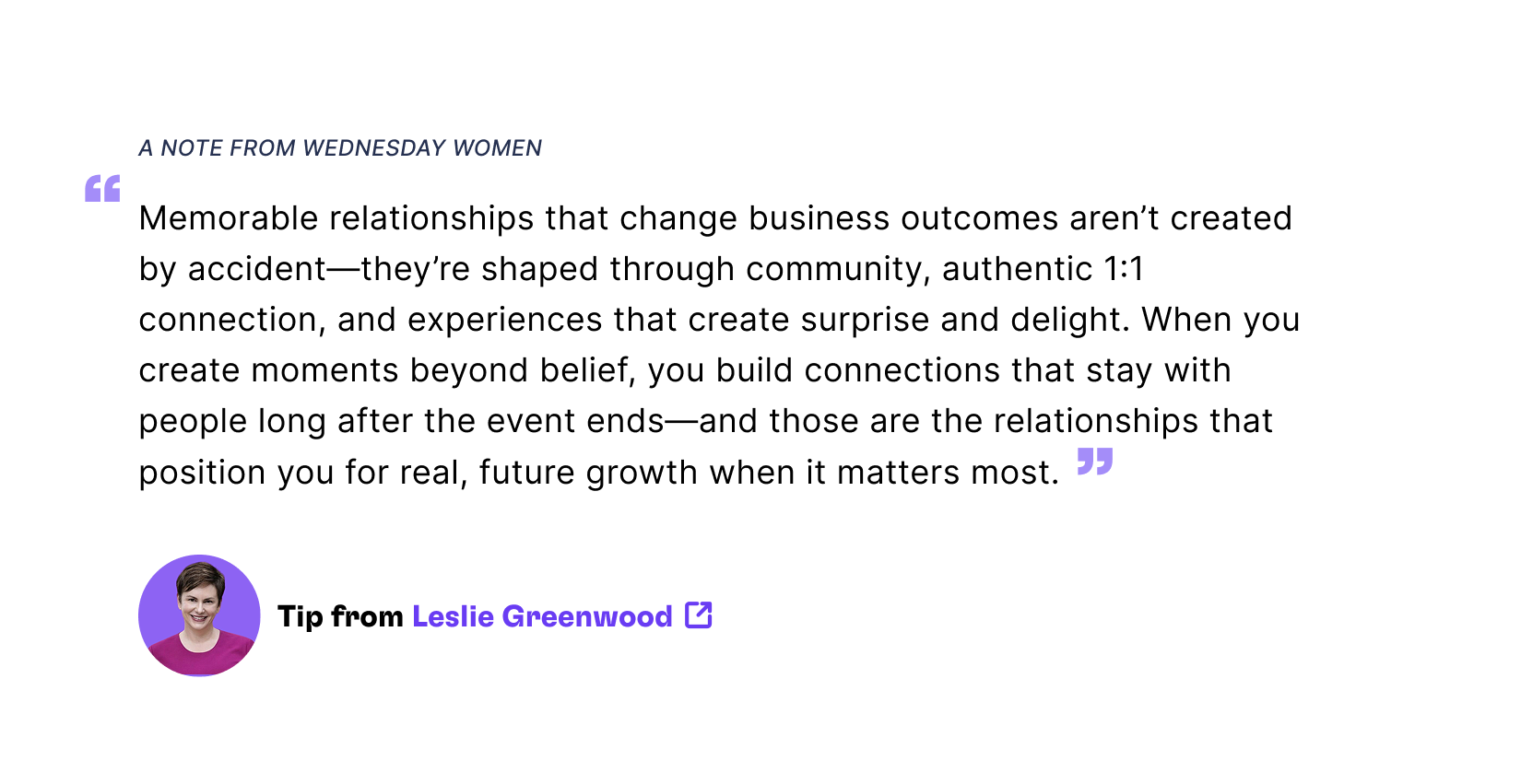
Tapping into your network requires sellers to build relationships and activate them strategically to create pipeline and revenue opportunities. The best sellers are deliberate about how they connect, engage, and turn their relationships into warm paths for introductions.
Stay Connected Consistently
Sellers already use multiple channels to keep relationships alive. According to our survey, the most common ways include:
- Email: 78.1%
- In-person events: 61.5%
- Social platforms: 46.4%
The key is consistency and intentionality. A quick check-in email, commenting on a LinkedIn post, or attending an industry event to reconnect can make the difference between a dormant contact and a potential warm path.
Actionable Tips:
- Schedule regular touchpoints with key contacts across different channels.
- Keep interactions personal and value-driven, not transactional.
- Track outreach in your CRM to ensure relationships don’t fall through the cracks.
Tap Into More Sources for Warm Paths
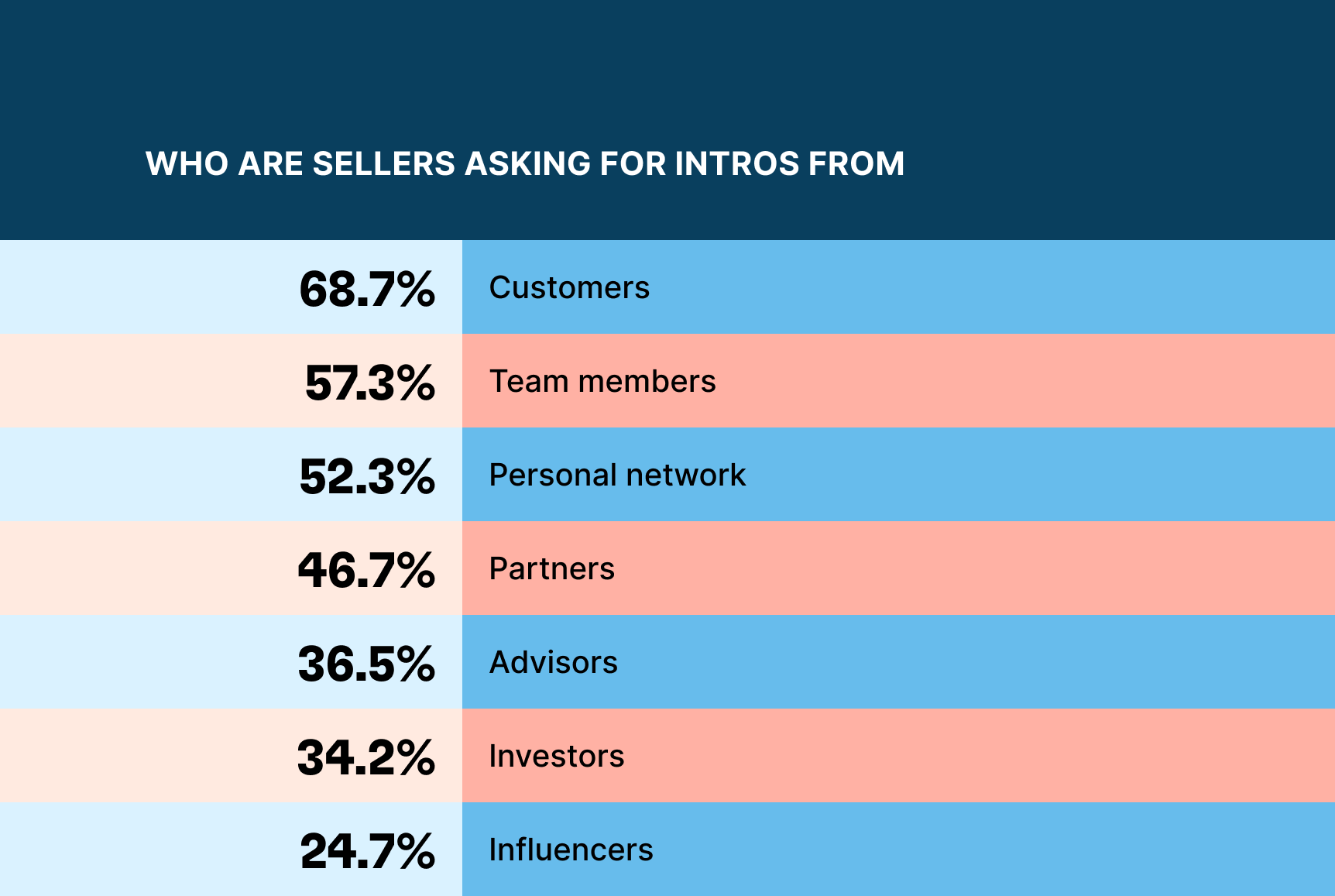
Sellers often overlook potential sources of warm introductions. Warm paths aren’t limited to customers, you can expand your reach across multiple networks:
- Customers: 68.7% of sellers report generating warm opportunities here
- Team members: 57.3% leverage colleagues and peers
- Partners: 46.7% tap into external alliances
The broader your sources, the more opportunities you unlock. Warm introductions work because they come from trusted connections so identifying all potential sources in your ecosystem is critical.
Actionable Tips:
- Map your network using softwares like Commsor to classify contacts by category: customers, peers, partners, mentors, and personal connections.
- Ask for intros strategically: identify who can connect you to the right decision-makers, and provide context to make it easy for your contact to help.
- Share updates and wins with your network to maintain visibility and credibility.
Be Intentional About Activation
Building a network is only half the battle; activating it consistently is where pipeline is generated. This means turning your existing relationships into warm introductions with purpose and clarity.
Actionable Tips:
- Set measurable goals for warm-intro activity (e.g., 5 intros per month).
- Prepare context and talking points for the person making the intro, so they can confidently connect you.
- Follow up quickly and report results thank the connector, update them on progress, and nurture the relationship for future opportunities.
- Post regularly on your LinkedIn to show your network value and remain top of mind to your network
Download the guide to use get access to worksheets to help you get started!

Conclusion
In Tandem with Wednesday Women
Leading With Relationships, Building With Purpose
At the heart of Wednesday Women are two founders who believe deeply in one thing: relationships move the world forward. Leslie Greenwood and Melissa Moody didn’t set out to build another business community.
They set out to build a movement—one that recognizes the extraordinary women leading across industries and amplifies them through the power of connection, visibility, and genuine human support.
Both founders came to Wednesday Women after decades in roles where relationships weren’t just “nice to have”—they were the engine.
Leslie has long been regarded as an expert in community-led growth, partnering with companies, executives, and high-growth teams to turn relationships into meaningful business outcomes. Melissa spent her career at the intersection of brand, marketing, and human-centered product building, leading growth-stage startups and championing relationship-driven strategies long before they became buzzwords.
Together, they share a conviction that has shaped Wednesday Women from day one: the warmest relationships create the strongest results.
Their message to you: Turn small ripples into big waves.
It’s about creating a movement of connection-driven success where small ripples of introductions, mentorship, and support build into big, visible waves of opportunity.
Leslie Greenwood and Melissa Moody
Your Network is The Advantage
Intentional network building requires you to strategically identify sources, maintain relationships, and activate them in ways that create tangible pipeline.
Sellers who consistently put in the effort to build and leverage their network will close deals faster, drive higher-value opportunities, and turn relationships into a predictable engine for revenue.